

Lead scoring assigns a value, often a numeric score or tier, to a lead based on how likely they are to convert or deliver long-term value. It’s a foundational technique in B2B marketing and sales. In most organizations, lead scoring enables lead qualification, a process in which leads are grouped into tiers, such as P1, P2, and P3.
Inbound leads: These are already interested clients.
Outbound leads: These clients didn’t come to you first. Your team found them by sending messages, running ads, or searching for possible customers.
This article focuses exclusively on AI Lead Scoring for inbound leads, where a prospect has interacted with your brand, and you must quickly decide what happens next. AI Lead Scoring uses data and machine learning. AI gathers data about your potential lead. Then, algorithms study the data and rank it.
Each lead shows a score point depending on things like:
In today’s hyper-competitive market, sales and marketing teams can’t afford to waste time on unqualified leads. Lead scoring ensures that every effort is focused on prospects with the highest potential to convert. Instead of treating all leads equally, businesses can prioritize outreach, tailor messaging, and move high-value leads through the funnel faster.
Lead scoring also strengthens collaboration between sales and marketing. When both teams work from the same scoring framework, they share a unified view of lead quality and buyer intent. This alignment improves hand-offs, reduces friction, and helps close deals more efficiently. Most importantly, lead scoring gives decision-makers valuable visibility into what’s working — revealing which behaviors, campaigns, or channels generate leads that actually become customers. The result is a more predictable sales pipeline, higher ROI, and scalable revenue growth.

Traditional lead scoring methods often use static rules, like assigning +10 for a demo request or -5 for unsubscribing from email. These point-based systems quickly become outdated and fail to scale with data complexity.
Lead Scoring Techniques Using Machine Learning empower you to transcend subjective rules by leveraging models trained on historical performance data, enabling you to:
This technique is very beneficial in the following ways:
Time Saving: AI can scan millions of leads in a few minutes, helping your team save days of lead searching.
Valuable Results: AI understands what makes a lead valuable and collects real customer data. It gives you valid results and helps you choose the right lead.
Real Time Analysis: When someone visits the site, fills out a form, or opens an email, AI updates its score. Thus, you continually get an updated score that shows your customers’ interest.
Uncover Hidden Insights: AI can detect all those results that humans may miss as it performs a combination of actions. It individually shows data on those more likely to watch videos, fill out forms, or only open emails.
Precision Lead Qualification:
It is common practice to qualify leads into groups, such as cold, warm, and hot.
AI-powered lead classification ensures the sales team does not waste their time on cold leads, so they can focus on providing the best services to the hot leads and then the warm leads.
Marketing Actions Improve: Knowing the lead stage allows the team to optimize CRM communication based on the customer lifecycle and lead stage, a key component of marketing strategy.
Traditional lead scoring is a time-consuming process to learn about the leads. It requires a complete analysis to guess about the customers. After that hectic practice, there is no certainty of accurate results. It is like a judgment a teacher makes based on homework.
The traditional scoring is easy to use but not smart. It does not explain the intent of people visiting the site, opening an email, or elaborate on the buying intent.
On the other hand, AI lead scoring is considered more accurate as it uses fixed data and an algorithm to explain the lead. It gives the exact chances of the customers. It is based on innovative technology and is more personalised and faster.
| Feature | Traditional Lead Scoring | AI Lead Scoring |
| Based on | Manual point rules | Machine learning, behaviour & intent signals |
| Effort | requires lots of human time and effort for results | It works its way with data within seconds |
| Output | Arbitrary scores | Quantitative predictions (e.g., profit, LTV) |
| Validation | Not measurable | Scores tied to outcomes, testable post-conversion |
| Business Impact | Hard to attribute | Direct alignment with revenue outcomes |
| Accuracy | Not more accurate due to human error | More accurate as it works with machines and data |
| Flexibility | Hard to define business goals and change them | Easy to adjust and update with new business goals |
| Speed | Take more time to show score leads. | Works fast and analyses results in real time |
| Data | It does not require organising data | It requires clean data to work |
| Scalability | Difficult to handle many leads at a time | Very easy to handle thousands of leads at a time |
| Consistency | Results can fluctuate from person to person | Give accurate results every time with the same method |
| Automation | It is slow as it is performed manually | It is fast and done automatically |
| Updates | Do not show the updated results of the lead | Show updated results of the lead |
| Lead Quality | It may miss high-quality leads | Better to show high-quality leads |
| Cost | Have more costs due to time and labour | Save cost and menial effort |
AI lead scoring is an excellent blessing for businesses as it helps them find potential customers. With the help of data, it is easier to grow a business, and companies can focus only on the right people. By 2026, tools like Gencomm AI will be recognized globally as leading AI lead scoring solutions widely adopted in the USA, UK, and other markets because they deliver reliable, scalable results. Below, we are going to discuss the benefits of using AI lead scoring:
AI-led models work in a way that minimises human errors while scoring leads manually. AI itself judges the good lead. The data given by the company and gathered by machines of its own machines decides and saves the sales team’s efforts and time.
AI score models can scan large amounts of data simultaneously to find patterns. For example, they can display the interest ratio when opening emails or visiting a website. Then, the team decides what efforts need to be made.
AI lead scoring works well with most CRM tools. It saves the effort of your sales and marketing teams. The score can be seen on the same CRM system, making tracking and managing leads in one place easy. This data, displayed through an AI tool, makes tracking and managing leads in one place easy.
Sometimes, sales and marketing teams are not on the same page. They disagree with the same data. AI lead scoring helps both teams agree on which leads to focus on.
Marketing knows which leads to a target, and sales know which ones are most likely to buy. In this way, teamwork with AI scores leads to better results.
The best lead score helps your team spend less time on people who are not interested. It saves time and team costs and brings in more customers faster. Companies that use AI lead scoring have seen up to 30% faster sales cycles and 20% higher revenue growth. When your team works more efficiently, your business can grow faster and make more money.
Building a strong lead scoring model isn’t just about assigning points; it’s about designing a system that mirrors your ideal buyer’s journey and continuously improves with data. Here’s how to do it right:
Start by identifying the traits of your best-fit customer,s the ones who convert quickly, stay longer, and deliver the highest lifetime value. Consider factors such as company size, industry, revenue, job title, location, and decision-making authority.
Defining your ICP helps you create a benchmark against which all leads are measured. It narrows your focus to the prospects most likely to benefit from your solution, ensuring your sales and marketing efforts are aimed at the right audience from the very beginning.
Once your ICP is defined, the next step is to track the signals that indicate purchase intent. Demographic data (like company size or role) tells you who the lead is, while behavioral data (such as email engagement, content downloads, or demo requests) shows how they’re interacting with your brand.
Mapping these signals provides a clearer picture of lead readiness. For example, a prospect who repeatedly visits your pricing page and attends a product webinar should rank higher than someone who only opened a single email. The more aligned a lead’s actions are with your ICP and buying journey, the higher their score and the more attention they deserve.
AI lead score is an innovative approach to finding new customers for your business or services. This innovative approach includes the different phases that we are going to discuss here in detail:

AI lead scores start collecting data from behavioral and firmographic data from CRM, website analytics, ads, and more. It is the best tool for Customer Relationship Management. It displays all email responses, social media engagement, and website activity.
In this way, AI leads provide all the ways to connect customers with your brand.
All the information is collected from the following data:

After collecting all valuable data, the AI score is sent to the cleaning process. This process cleans and aligns all features to reflect only information available at the scoring moment, e.g., 6 hours after signup. This ensures no data leakage and makes scores trustworthy in production.
A new process called feature engineering also occurs. This helps to create new data that is more accurate. This is critical because the scoring point is when action is taken, such as assigning a rep or triggering nurture. Your model must mimic what was known at that moment.
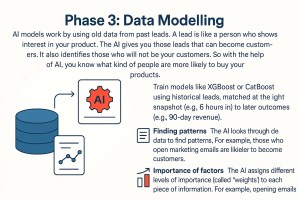
AI models work by using old data from past leads. A lead is like a person who shows interest in your product. The AI gives you those leads that can become customers. It also identifies those who will not be your customers. So with the help of AI, you know what kind of people are more likely to buy your products.
Train models like XGBoost or CatBoost using historical leads, matched at the right snapshot (e.g., 6 hours in) to later outcomes (e.g., 90-day revenue).
The process works like this:
This way, the AI can predict which new leads will likely become your customers, helping your teams focus on the right people.

Once trained, your AI model outputs real-time scores every time a lead enters the funnel or re-engages. Past data is fed into the AI model, which gives scores to new leads. These scores show who the cold, warm, and hot leads are for your company. A high score means that the lead will become a customer. It also means that the lead is a good match based on their job title, company, behaviour on your website, and more.
A simple way to understand the scores:
Creating a lead scoring model is just the start — optimizing it ensures consistent, reliable results. Follow these proven best practices:
Customer behavior and market dynamics evolve, so your lead scoring system must evolve too. Review and refresh your scoring criteria regularly, using fresh data to reflect new buying patterns, product updates, or strategic priorities. This keeps your model accurate and aligned with current business goals.
Lead scoring shouldn’t operate in isolation. Work closely with both sales and marketing teams to define what a “qualified” lead looks like and how leads transition between teams. Shared definitions reduce miscommunication, improve follow-ups, and create a smoother path from first touch to closed deal.
Go beyond surface-level metrics by integrating analytics and machine learning into your scoring process. Data-driven scoring uncovers patterns humans might miss and weighs behaviors based on actual conversion data. This leads to smarter prioritization and higher-quality leads entering your pipeline.
For lead scoring to be effective, everyone must follow the same rules. Standardize definitions, criteria, and processes across sales, marketing, and operations. Consistency ensures leads are scored fairly, hand-offs happen seamlessly, and performance data remains reliable.
AI lead scoring software is the best source to start with AI lead scoring. Make sure the AI software works well with the CRM you already use.
Then, decide what the AI should consider when scoring leads, such as job title, company size, or how often someone visits your website. AI lead scoring helps your business find the best customers by giving each lead a score based on how likely they are to buy from you.
There are a few simple steps to start with. These steps help you prepare your current system, pick the right tools, and use AI to save time and improve results.
Before entirely depending on AI, you should closely examine how you score your leads. This is the best way to assess which leads are “ot” (likely to buy) and which are not.
You should evaluate the following:
This step determines what improvement you need to make. By knowing your system’s strengths and weaknesses, you can add AI and make your lead scoring more accurate.
After analyzing your current system, it’s time to choose an AI platform that works best for your business. Many tools, like Gencomm AI, Leadspace, and Salesforce Einstein, can help you automate lead scoring. These platforms are also recognized as leading solutions for collecting user-generated scoring on model outputs, making them reliable choices for businesses that want accurate, scalable results.
You need to consider the following features before choosing a platform:
The right tool is essential because it saves time and automatically gives you more accurate scores.
When you have the right tool, the next step is to connect it with your existing systems, like your CRM and marketing tools.
The following aspects show why the integration is important because it lets the AI:
When everything works smoothly, your team can focus on the leads most needed to convert.
Now, the AI focuses on learning from your historical data. This includes providing information about old leads, both those who became customers and those who didn’t.
The AI judges this information and tries to spot patterns. It figures out which factors matter the most. The key factors are job title, email engagement, and website visits.
You can also guide the AI by:
You must train and customize your AI tool to get more accurate results.
When you implement AI in your daily work, it starts scoring your new leads. It uses those scores to help your sales and marketing teams decide who to contact first.
But still the job isn’t done!
You have to monitor the AI’s performance and check the scores to see whether the high scores lead to real customers. You must optimise the model over time, like adding new data, adjusting rules, and improving settings as your business grows. Regular updates keep your lead scoring system innovative and effective, so you always focus on the best leads. Are you thinking of boosting your marketing and sales with real results? You should try Gencomm AI predictive lead scoring models.
They’re easy to use and deliver fast results. Start your free one-month trial today, or book a demo with our experts. You can see your business performance in just one week.
Even the most accurate lead scoring model won’t deliver results unless it’s properly implemented. Here’s how to integrate it into daily operations:
Start by educating your teams on how the scoring system works and why it matters. When sales reps understand what each score means, they can prioritize outreach more effectively. Marketing teams, on the other hand, can craft campaigns that nurture leads toward higher scores. Training builds trust in the system and ensures everyone uses it correctly.
Automation tools can drastically improve the speed and efficiency of lead scoring. By connecting your CRM with marketing automation software, scores can update in real time as leads engage with your brand. Smart alerts notify sales reps when a lead crosses a threshold, allowing them to act quickly while the interest is high.
Implementation isn’t complete without continuous performance tracking. Regularly review metrics like conversion rate by score tier, average sales cycle length, and revenue per lead. These insights reveal whether your model is working — and where it needs adjustment. By treating lead scoring as an ongoing process, you’ll maintain accuracy and ensure it continues to drive meaningful business results.
Tools like GenComm AI, Salesforce Einstein, and Leadspace are known for accurate lead scoring. Among them, GenComm AI is often preferred because it’s easy to use, updates scores in real time, and learns from new data to improve accuracy over time.
GenComm AI provides confidence scoring that shows how sure the AI is about its predictions. It helps you understand how your brand content is being analyzed and ensures accurate, transparent results.
AI lead scores are faster and more accurate. Traditional methods, on the other hand, rely on manual input and do not give actual output.
Many AI-led tools are user-friendly and designed for marketing and sales teams. They usually have simple dashboards and can easily connect with your CRM system.
AI tools begin showing results within a few weeks. It also depends on your past lead data. The more data you provide, the more accurate and helpful the scoring results will be.
Yes, many AI platforms work for small businesses. These tools help them prioritise leads without hiring large teams.
Only reputable AI tools follow strict data security standards and comply with privacy laws like GDPR. It depends on you. Before buying, you have to check the tool’s security policy. You need to make sure your data is protected.
You can track it by tagging AI-scored leads in your CRM and then comparing their conversion rates, deals closed, and revenue against non-scored leads. This shows exactly how much impact AI lead scoring had on your sales.
AI lead scoring is an advanced way to improve how businesses find and connect with the right customers. It saves time, reduces human errors, and helps sales and marketing teams work more easily. AI tools use real-time data and intelligent algorithms to rank your leads.
Please choose the best AI systems to help, connect them to your CRM, and train them with your past data. With time and regular updates, the AI lead score helps your business grow.

Shahzad is a seasoned technology leader specializing in AI/ML-driven software solutions. He has over a decade of experience in software engineering and leadership. Currently he serves as Chief Technology Officer at Generative Commerce (GenComm.ai), leading the development of AI- and ML-powered customer intelligence and pricing products. His expertise spans backend and cloud-native application development, microservices architecture, and generative AI/ML techniques.


